
Categories
Real Estate Advice, Buyer Tips, Home Buyer, FloridaPublished September 18, 2026
Buying a Second Home or Investment Property in Sarasota: What Snowbirds and Investors Need to Know
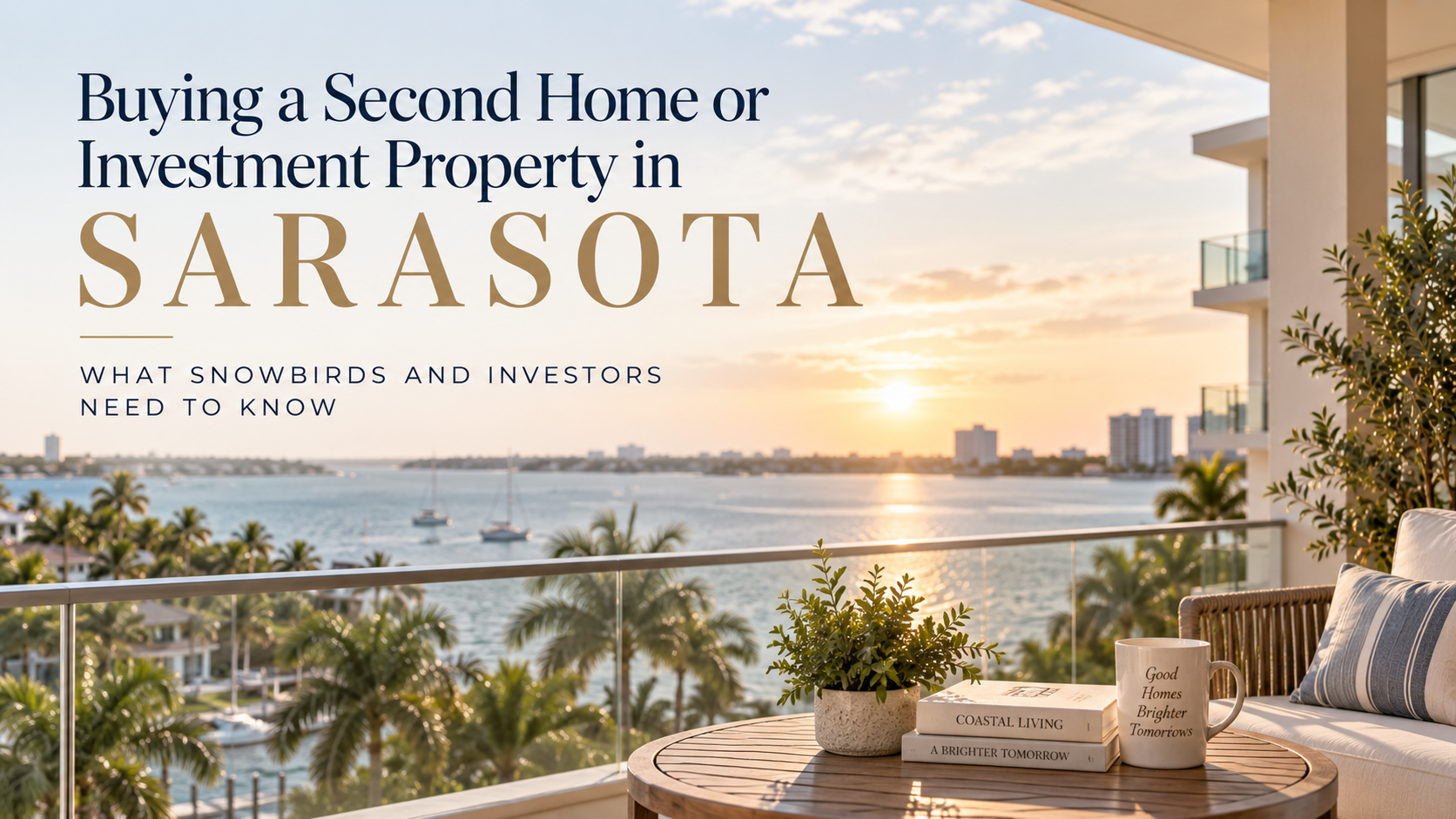
Buying a Second Home or Investment Property in Sarasota: What Snowbirds and Investors Need to Know
By Traci Bolen | Sand Sea Homes | eXp Realty Serving Sarasota, Manatee, and Charlotte County
Quick answer: A second home and an investment property are different purchases to your lender, insurer, and the IRS. In Sarasota, Manatee, and Charlotte County, a second home can mean as little as 10% down while an investment property typically requires 15% to 25%, and neither qualifies for Florida's homestead exemption or Save Our Homes cap.
A second home and an investment property are not the same purchase in the eyes of your lender, your insurer, or the IRS, even if the house itself looks identical. That distinction affects your mortgage rate, your down payment, your taxes, and in some communities, whether you're even allowed to rent the place out. If you're buying here as a snowbird, a future retirement home, or a rental investment, here's what actually differs before you write an offer.
Second Home or Investment Property in Sarasota: Why the Label Matters
Lenders classify every purchase as a primary residence, a second home, or an investment property, and the classification changes your loan terms meaningfully. A second home mortgage generally requires that you personally use the property for part of the year and that you not rent it out for profit; some lenders allow limited rental use, but the property can't be operated primarily as income real estate. An investment property, by contrast, is one you plan to rent out, and it comes with a higher down payment requirement, typically 15% to 25% versus as little as 10% for a second home, along with a somewhat higher interest rate to reflect the lender's added risk.
The practical step: be honest with your lender upfront about how you actually plan to use the property. Misrepresenting a rental as a personal second home to get better loan terms is mortgage fraud, and lenders do audit for exactly this pattern.
Property Taxes: No Homestead Exemption Here
This is the biggest tax difference most out-of-state buyers underestimate. Florida's homestead exemption and Save Our Homes assessment cap, discussed in our post on hidden buying costs, only apply to your primary residence. A second home or investment property gets none of that protection: it's taxed at full assessed value with no cap on annual increases and no exemption reducing that value. If you're comparing your future tax bill to what a full-time Florida resident pays on a similar home, expect yours to run meaningfully higher.
The practical step: budget your property tax estimate based on the full, uncapped assessed value, not a number a homesteaded neighbor mentions casually.
Insurance: Occupancy Status Changes Your Quote
Insurers price policies differently based on how a home is occupied. A property that sits empty for months at a time, common with snowbird second homes, carries somewhat different risk than a full-time residence, since unoccupied homes can go longer before a leak, storm damage, or an HVAC failure is even noticed. Rental properties add another layer: landlord policies (sometimes called DP-3 or dwelling-fire policies) differ from standard homeowners policies and are priced to reflect tenant turnover and liability exposure.
The practical step: tell your insurance agent exactly how you plan to use the property, seasonal second home, rental, or a mix, before you get a quote, since the wrong policy type can leave you underinsured for a claim tied to your actual use.
HOA and Condo Rental Restrictions: Read Before You Buy, Not After
This is the single most common surprise for buyers planning to rent out a condo or HOA home here. Rental rules vary enormously by community: some allow unlimited rentals, others cap rentals to a handful of times per year with a required minimum stay, often 30 days, and some effectively prohibit short-term rental altogether. These rules aren't always obvious from a listing, and violating them after closing can mean fines or a forced end to your rental plans, with neighbors often the ones reporting violations.
The practical step: get the association's rental policy in writing before you make an offer if rental income is part of your plan at all, not after you've already closed and started marketing the unit.
Short-Term Rental Rules Beyond the HOA
Even in communities that allow short-term rental at the association level, Sarasota, Manatee, and Charlotte County each have their own local regulations governing vacation rentals, which can include registration requirements, occupancy limits, and licensing. These rules have shifted at the state and local level in recent years and can differ meaningfully block to block, particularly between unincorporated county areas and incorporated cities.
The practical step: confirm current short-term rental licensing requirements with the specific city or county before assuming a property can operate as an Airbnb or VRBO, and don't rely solely on what a listing description claims about rental potential.
A Note for Foreign Buyers
Florida's Interests of Foreign Countries law, SB 264, restricts real property purchases by individuals and entities connected to a specific list of "countries of concern," which as of 2026 includes China, Russia, Iran, North Korea, Cuba, Venezuela, and Syria. Restrictions vary by country: buyers connected to China face the broadest limits, generally restricted to a single residential property, on no more than two acres, at least five miles from any military installation, while other listed countries face somewhat different restrictions tied primarily to agricultural land and proximity to military or critical infrastructure sites. A federal appeals court upheld the law's constitutionality in a ruling issued in late 2025, so this is settled law buyers should plan around rather than assume might be struck down.
The practical step: if this applies to you, work with a real estate attorney early in the process, before you identify a specific property, since the restrictions affect what you're even eligible to purchase.
The Retirement-Home Angle
If you're buying now with an eye toward eventually making this your full-time home, it's worth thinking through the timeline explicitly. You won't qualify for the homestead exemption or Save Our Homes protection until the property becomes your primary residence and you establish Florida residency, generally requiring you to own and occupy the home as of January 1 and file for the exemption by March 1 of that year. Some buyers in this position choose to accelerate that transition once they're ready, both for the tax benefit and because primary-residence mortgages often carry better terms than second-home loans.
The Bottom Line
Whether you're buying a place to spend your winters, a future retirement home, or a straightforward rental investment, the honest answer to "how should I structure this" depends on details that are easy to overlook from a distance: how your lender will classify the purchase, what your actual tax bill will look like without a homestead exemption, whether your target community even allows the rental use you're planning, and whether any foreign ownership restrictions apply to your situation. None of these are reasons to avoid buying here. They're simply the details worth nailing down before you're under contract, not after.
Frequently Asked Questions
What is the difference between a second home and an investment property?
Lenders classify every purchase as a primary residence, second home, or investment property. A second home generally requires personal use and no rental for profit, with as little as 10% down, while an investment property typically requires 15% to 25% down and a somewhat higher interest rate.
Do second homes in Sarasota get the homestead exemption?
No. Florida's homestead exemption and Save Our Homes cap only apply to your primary residence, so a second home or investment property is taxed at full assessed value with no cap on annual increases.
Can I rent out a Sarasota condo or HOA home?
It depends on the community. Rental rules vary enormously, from unlimited rentals to minimum stays of often 30 days to effective prohibition, so get the association's rental policy in writing before making an offer. Sarasota, Manatee, and Charlotte County also each have their own vacation rental regulations.
How does occupancy affect insurance on a snowbird home?
Insurers price policies by occupancy. A home that sits empty for months carries somewhat different risk than a full-time residence, and rental properties need landlord policies, sometimes called DP-3 or dwelling-fire policies.
When can a second home become my homestead?
You won't qualify until the property becomes your primary residence and you establish Florida residency, generally by owning and occupying the home as of January 1 and filing for the exemption by March 1 of that year.
Planning a second home, retirement property, or rental investment in Sarasota, Manatee, or Charlotte County? Let's map out the right approach for your specific situation. Schedule a consultation with Traci today.
Sand Sea Homes | eXp Realty | Serving Sarasota, Manatee, and Charlotte County
#SarasotaRealEstate #SnowbirdSeason #InvestmentProperty #SecondHome #SandSeaHomes #TraciBolen #eXpRealty #GulfCoastRealEstate #ManateeCountyRealEstate #CharlotteCountyHomes #FloridaRealEstate #VacationRental
Traci Bolen
Owner / Realtor | Sand + Sea Homes
or another way